Building a real-time bidding marketplace app: what to plan for
A bidding app is a marketplace where the price moves while people watch. Here's what that changes: how live auctions stay fair, what the marketplace around them needs, how to handle payments and trust, and the stack we used to build Smart Marketplace.
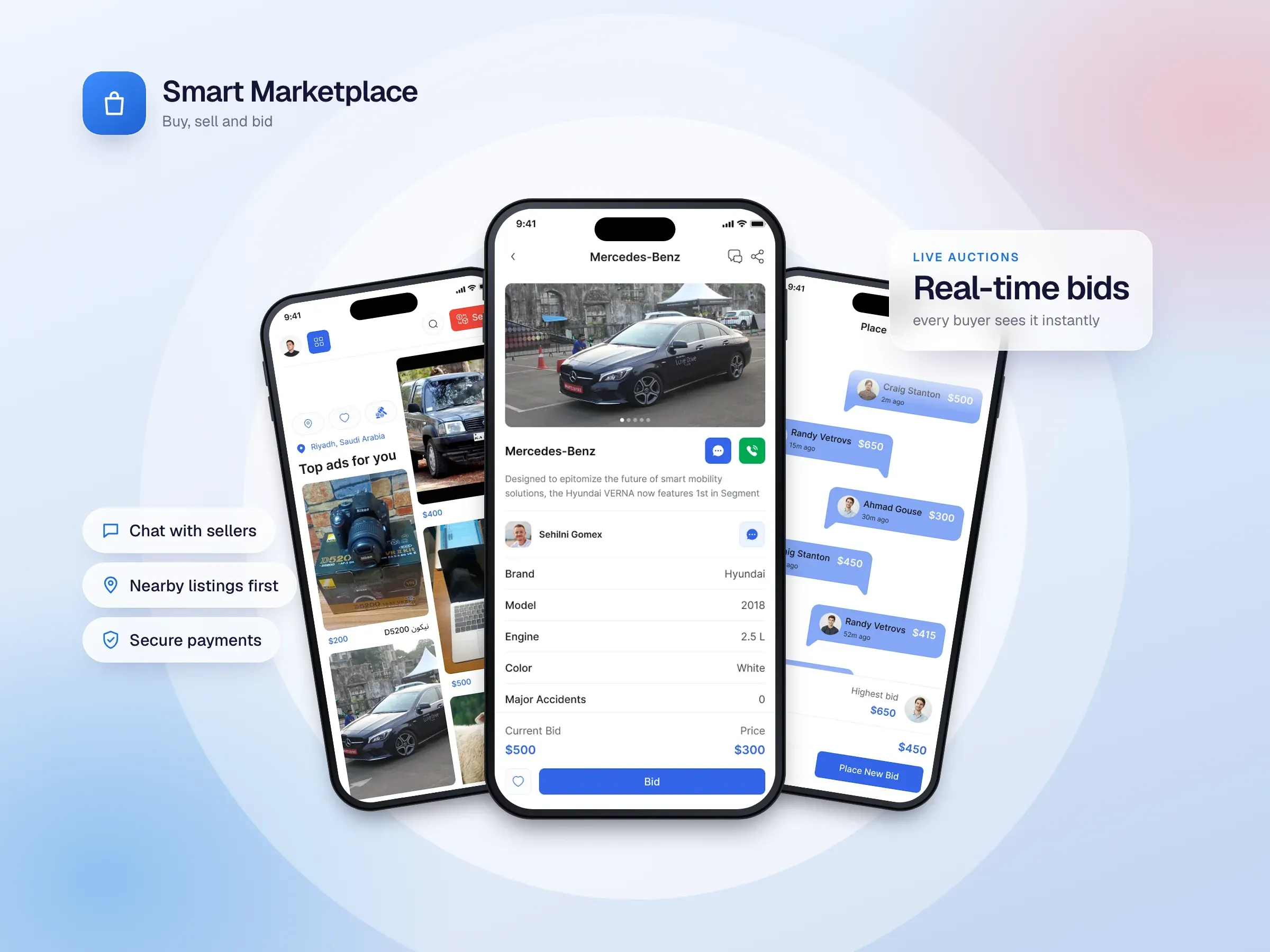
A bidding app looks like a classifieds app with one extra feature: a price that goes up. That one feature changes most of the engineering. In an ordinary marketplace, a screen can be a second out of date and nobody notices. In an auction, everyone has to see the same price at the same moment, and exactly one person can win. This guide covers what to plan for, using Smart Marketplace, a buy, sell and bid app we built for a client, as the example.
How a live auction stays fair
In short: the server decides every bid in a single step, everyone sees the same clock, and new bids are pushed to every screen the moment they happen. Here’s what each of those means.
The server decides, the phone asks. The current highest bid lives in one place: the server. A phone never sets the price; it sends a bid and waits for an answer. Each bid is checked against the current highest and accepted or rejected in a single step, so two people who tap at the same moment can’t both be told they’re winning. In Smart Marketplace this meant auction logic that prevents race conditions and tracks bids accurately even when the network is slow.
One clock for everyone. Phone clocks disagree by seconds, and an auction is decided in seconds. The countdown people see should come from the server’s time, not their own device’s.
Updates are pushed, not fetched. Nobody should have to pull down to refresh to see they’ve been outbid. Smart Marketplace uses Socket.IO to push new bids, status changes and messages to every open screen the moment they happen.
A plan for bad connections. People bid on trains and in lifts. When the connection drops and comes back, the app should ask the server for the auction’s current state rather than trust what it thinks it missed. With hundreds of people connected at once, how connections are pooled and recovered needs as much care as the bidding itself.
Notifications when the app is closed. Being outbid, an auction about to end, a win: these have to reach people who aren’t looking. Smart Marketplace sends push notifications for auctions and messages.
Decide the auction rules before you design
These are product decisions, but each one changes the code, so settle them on one page first:
- The minimum step. How much higher does the next bid have to be?
- The last seconds. Does a late bid extend the auction, so nobody wins by timing alone, or is the end time fixed?
- A reserve. Can a seller set a price below which the item doesn’t sell?
- Buy now. Can an item be bought outright while it’s also up for auction? If so, it must never sell twice. Keeping stock in sync during purchases that happen at the same moment was one of the harder parts of Smart Marketplace.
- When the winner doesn’t pay. Does the item go to the next bidder, or back on sale?
The marketplace around the auction
The auction is the headline, but most of the app is the marketplace it sits in.
Listings that differ by category. A car, a flat and a jacket need different fields. Smart Marketplace covers vehicles, properties, electronics, fashion, services and crafts, which called for a flexible data structure in MongoDB and carefully chosen indexes, so that searches across many filters still answer in under a second.
What’s nearby. Buyers care about distance. Showing nearby listings first takes location queries and caching that stay fast as the catalogue grows.
Photos. Listings live on their pictures, and sellers upload a lot of them from phones. Images are compressed on the device, uploaded in chunks, then resized and served through a CDN.
A direct line between buyer and seller. Questions sell items. In Smart Marketplace, instant messaging runs over Socket.IO, like the bids.
Payments and trust
A marketplace only works if strangers trust it with their money.
Payments. Use an established payment gateway and let it handle card details, so they never sit on your own servers. Then plan the unglamorous parts: matching every payment to its order, refunds, and what happens when a card payment is disputed.
Trust. Smart Marketplace has seller verification and reputation, ratings, and a review process for listings that combines automated checks with people. Decide early how disputes are settled and whether the platform holds the buyer’s money until the item arrives.
The law. Rules on auctions, on holding other people’s money and on consumer rights differ from country to country. Take advice for the markets you plan to launch in before you build the payment flow.
The stack we used
| Part | What Smart Marketplace uses |
|---|---|
| App | Flutter, with GetX for state management |
| Live bids and chat | Socket.IO |
| Backend | Node.js |
| Database | MongoDB |
| Caching | Redis |
| Hosting and files | AWS EC2 and S3, with a CDN for images |
| Also | A payment gateway, push notifications and location services |
Flutter is a good fit here because a bidding screen is full of state that changes without the user doing anything: the price, the countdown, the chat, a payment in progress. Our FlutterFlow vs Flutter comparison explains why apps like this are written in plain Flutter.
What to build first
A first version doesn’t need every feature. A sensible starting point is listings, search, one type of auction, payments, chat and notifications. Groups, recommendations and extra auction formats can follow once real people are bidding. Our guide to how long a mobile app takes explains why real-time features are the part to budget time for.
Our advice
Write the auction rules down before anyone opens a design tool. Then test the bidding with many simulated bidders on slow and broken connections long before launch, because that’s where auctions go wrong.
If you’re planning a marketplace or auction app, tell us about it and we’ll help you work out the smallest version worth launching.