AR/VRVR TrainingIndustrial Simulation
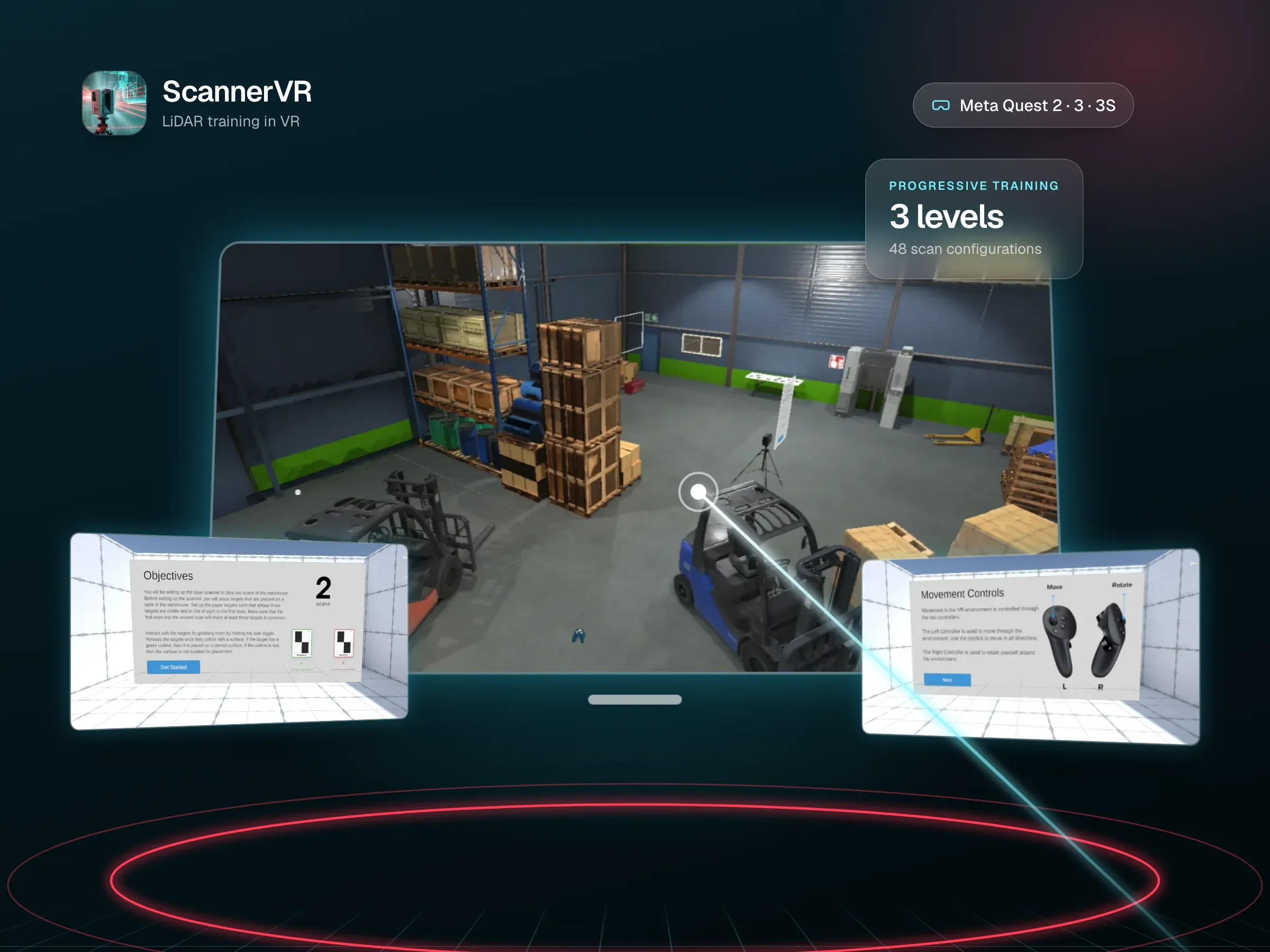
ScannerVRLiDAR Training Simulator
Meta Quest VR application simulating professional LiDAR scanning workflows with target placement, dual-scan verification, real-time raycasting, and point-cloud generation in progressive warehouse environments.
- Category
- AR/VR
- Built with
- Unity 6, C# Scripting, XR Interaction Toolkit +8 more
ScannerVR is a production-ready VR training simulator for Meta Quest that authentically recreates industrial LiDAR scanning operations from target placement through point-cloud validation. Users physically grab retroreflective paper targets from supply tables and snap them to warehouse walls using XR Interaction Toolkit grab physics with visual outline feedback. The tripod-mounted virtual scanner performs industry-standard 360° rotational scans, executing thousands of Unity Job System batched raycasts to validate line-of-sight to minimum three targets per position. The complete professional workflow requires dual scans—First Scan establishes baseline geometry from initial position, Second Scan from relocated tripod confirms overlapping registration and geometric stability—before generating dense point clouds visualized as cyan particle systems. Three progressive difficulty levels introduce escalating obstructions (crates, pallets, barrels, forklifts, machinery) forcing strategic scanner positioning and target layout decisions. Comprehensive training analytics capture time-on-task, target consumption, scan coverage percentage, and export structured JSON session data to persistent storage. Production features include 48 configurable scan resolutions via dual sliders, spatial audio feedback throughout (scan initialization beeps, target placement clicks, success/error chimes), head-tracked pause menus, async scene transitions with progress visualization, URP baked lighting maintaining 72fps standalone performance, and complete onboarding covering locomotion, controller interactions, and scanning objectives.
See it in action
What makes it work
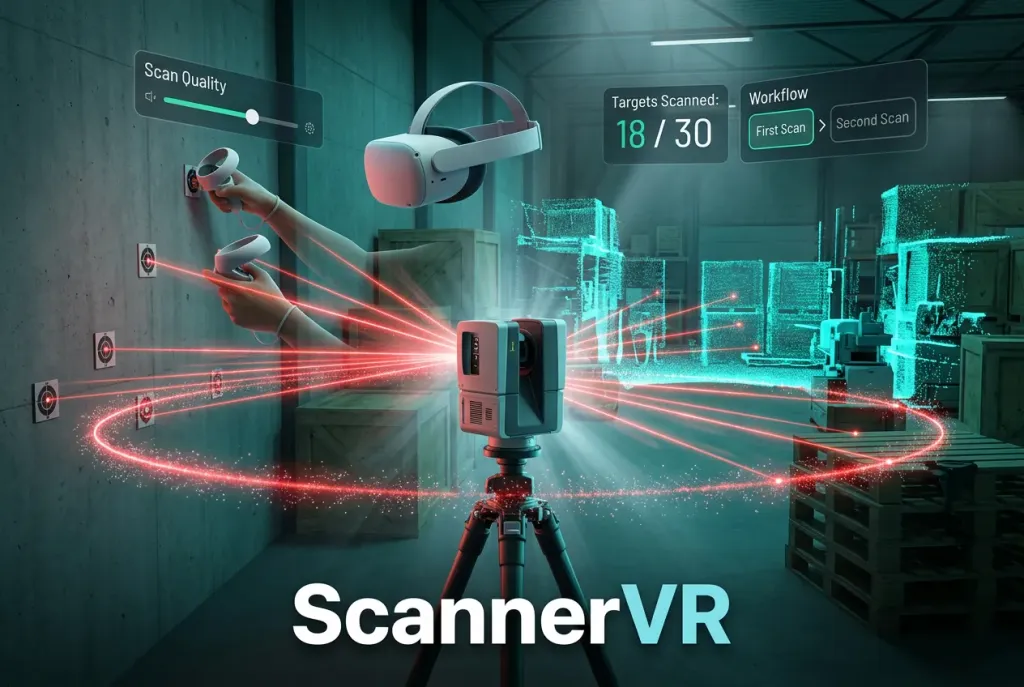
Authentic LiDAR workflow: physical target placement → dual-scan verification → point cloud generation
Physics-driven target handling with wall-snapping and collision feedback
Real-time 360° raycast scanning requiring 3 line-of-sight targets
Progressive difficulty (3 levels) with industrial obstructions (crates, forklifts, barrels)
48 scan configurations via dual resolution/quality sliders
Training analytics with JSON session export (time, coverage, targets used)
Complete onboarding: locomotion tutorial → interaction tutorial → objectives
Production audio: scanner beeps, placement sounds, success/error feedback
Spatial pause menu, async scene loading, progress visualization
URP optimized for 72fps Quest standalone performance
The challenge
The hard parts of building ScannerVR
7 problems we had to solve, from physics, 3D math, learning design and more.
- 01 / 07Physics
Authentic LiDAR physics
Replicating authentic LiDAR physics required implementing thousands of concurrent raycasts using Unity Job System while maintaining real-time feedback under Quest hardware constraints.
- 02 / 073D math
Registration without false positives
The dual-scan verification workflow demanded robust target registration algorithms that validated geometric consistency across scanner relocations without false positives.
- 03 / 07Learning design
Guidance vs. discovery
Balancing training guidance with discovery-based learning required carefully paced onboarding that taught locomotion, grabbing, scanning, and strategic decision-making without overwhelming VR newcomers.
- 04 / 07Performance
Industrial detail, smooth frames
Industrial environment fidelity vs. performance tradeoffs involved extensive LOD implementation, occlusion culling, and URP material optimization.
- 05 / 07UX design
Readable UI inside VR
Spatial UI legibility inside VR demanded multiple iterations on scale, contrast, and head-tracking behavior.
- 06 / 07Audio
Audio in step with every scan
Audio design synchronization across asynchronous scan operations, UI interactions, and spatialized environmental effects required precise event-driven architecture.
- 07 / 07Data
Research-grade session data
Session data integrity for research export needed bulletproof JSON serialization handling partial failures and edge cases gracefully.
7 of 7 solved
Got a problem like these? We’d like to hear about it.
Inside ScannerVR
Built with
- Unity 6
- C# Scripting
- XR Interaction Toolkit
- Unity Job System (raycast batching)
- Meta Quest 2/3/3S Optimization
- URP (Universal Render Pipeline)
- Particle System (laser effects)
- TextMesh Pro (spatial UI)
- Addressables (async loading)
- Spatial Audio
- Controller Haptics
Have a project like ScannerVR?
Tell us what you want to build. You’ll get a free discovery call and a clear, written proposal.
More work like this
All projects